
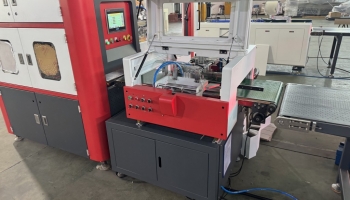
Think of a perfume box. When you open it, you see a printed cover, clean edges and a lid that fits neatly. Behind that result is a sequence of operations in which even a small error can show on the finished piece. If the greyboard is cut inaccurately, the corners are difficult to form. If the covering sheet shifts, the borders become uneven. If the adhesive is applied irregularly, bubbles and creases may appear.
LY machines cover different stages of this process. A manufacturer can start with separate workstations and build a line around the type of box and the required capacity.
Start with the box design
Production begins with the structure: internal dimensions, greyboard thickness, wall height, lid size and the width of the covering material that will turn over the edges. The greyboard is then cut, while the covering paper is printed and trimmed.
A box with a separate base and lid needs blanks for both parts. A book-style box also needs a rigid outer case. Some designs require grooves in the greyboard to create precise folding lines. This is why machine selection should begin with a sample or drawing of the finished box, rather than a target speed alone.
Giving the greyboard its shape: corner pasting
The cut blank is assembled into a box body. Tape secures the four corners so that the walls retain their geometry during wrapping.
For short runs and varied jobs, the LY-TJ-40 lets an operator feed the pieces and paste the corners in sequence. At higher volumes, the LY-750 automates this stage. These machines address the same production step at different levels of automation; a line does not necessarily need both.
Applying adhesive and positioning the box
Next, the printed covering sheet meets the assembled greyboard structure. The LY-SJ-850-A feeds the covering paper and applies adhesive. An even coating matters: too little adhesive weakens the bond, while excess adhesive may show at the edges.
The box must then be placed accurately on the glued sheet. The LY-850DN uses visual positioning to place components in rigid box and case production. This is the stage that determines whether the printed design will sit symmetrically on the finished box.
In some configurations, feeding, gluing and positioning can be arranged differently. The LY-485C-PK, for example, provides automated rigid case making with visual positioning. The right configuration depends on the product design and on the equipment already in the workshop.
Wrapping turns the structure into a finished box
Once positioned, the box moves to wrapping: the paper adheres to the walls, its free edges turn inward and the corners are formed. The LY-800A performs this operation in semi-automatic rigid box production.
At this point, the quality of all earlier steps becomes visible. Precisely cut greyboard, secure corners and accurate positioning produce even borders and a clean cover. After gluing, the LY-720A can press rigid cases and components evenly, helping the materials bond while keeping the piece flat.
A book-style box also needs an outer case
When the customer wants a box that opens like a book, the box body is only one part of the product. The outer case consists of greyboard pieces positioned at precise distances on a covering sheet. The edges are turned in, and the completed case is joined to the box body.
The LY-900SMB forms and turns in such rigid cases and covers. For short and medium runs that need a separate folding and adhesive application step, the LY-DT4350 + LY-500HJ combination is another option to consider. The exact sequence depends on the design: a box with a separate lid, a book-style box and a drawer-style box do not follow identical workflows.
From individual workstations to an automatic line
A flexible production setup can combine corner pasting, gluing and positioning, wrapping, and pressing. Operators transfer the work between stations. This can be practical when orders vary and jobs change frequently.
For a higher, more consistent output, the LY-HB1500CZ integrates key operations in an automatic line: material feeding, corner pasting, positioning, wrapping and forming. The route from covering sheet and greyboard to finished box is managed as one continuous process.
The best line is the one that makes your boxes at the required quality and volume. Send Graphotrade a photo or sample, the dimensions, greyboard specification and expected daily output. We can then discuss which stages to automate and how LY machines can work together in your production.
